read receipts
That 'Your Review Helps Others' Email Is a Pulse Check
The review request doesn't care about your five stars. It cares that you opened it.
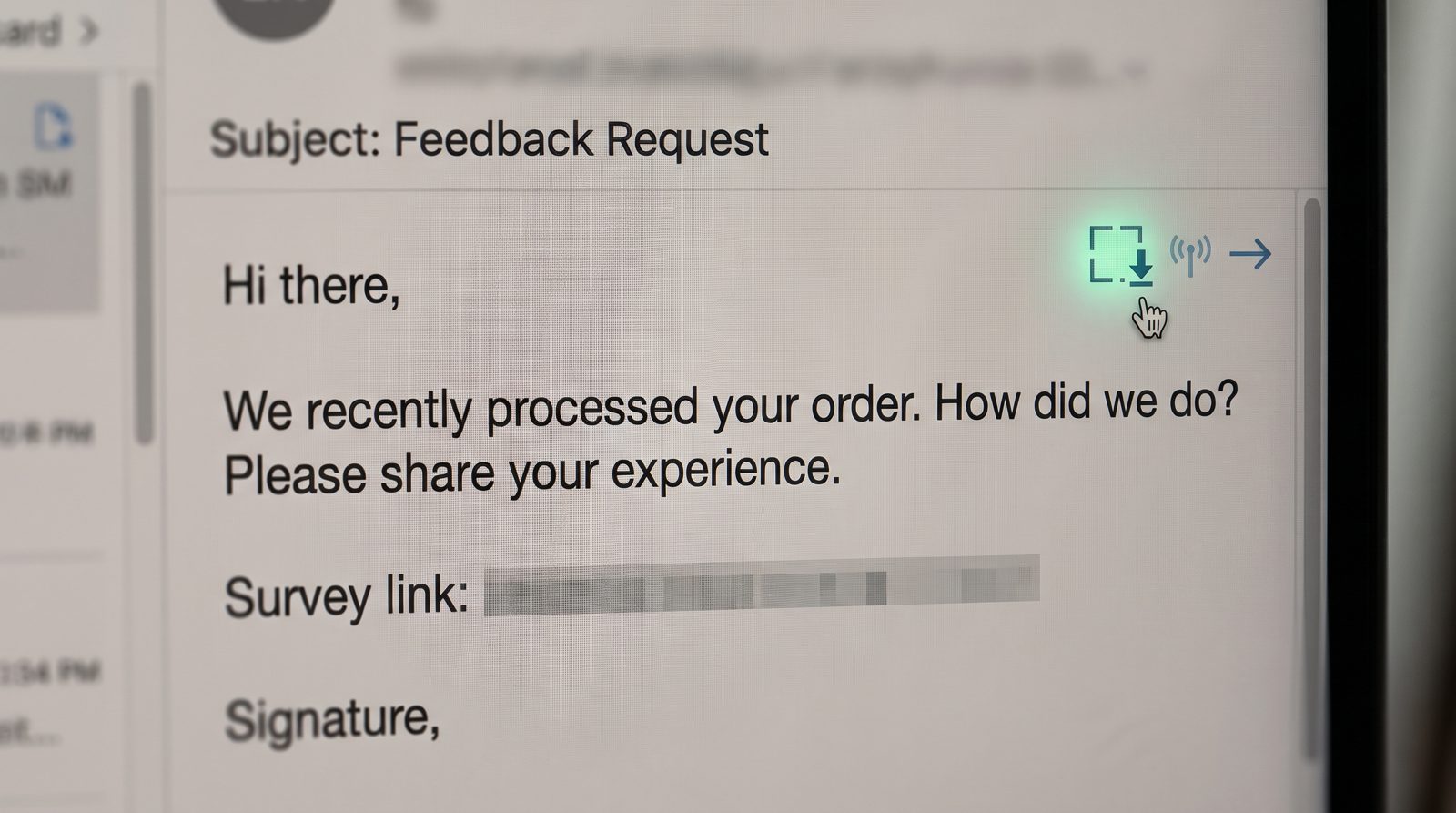
Every "How did we do?" and "We miss you!" email is, before anything else, a liveness test. When you open it, a one-pixel image loads from the sender's server, and that single request confirms your address is live, your client renders images, and a human is on the other end. That confirmation is worth money. Which is exactly why the lowest-value senders ask for the least from you.
Why would a company send me an email that asks for nothing?
Because the ask isn't the point — your reaction is. A review request or a "we haven't seen you in a while" note is cheap to send and designed to be opened out of mild guilt or curiosity. The moment you open it, a tracking pixel fires. That's a tiny transparent image, often 1×1, hosted on the sender's domain with a unique URL baked into your specific send. When your mail client fetches it, the server logs that the address at that URL pulled the image. Now they know the inbox is real, monitored, and reachable.
For a legitimate retailer, that feeds engagement scoring — who's still worth emailing. For a sketchy list broker, it does something colder: it turns "an address someone typed once" into "a confirmed live human," which is the difference between junk data and sellable data.
How does a pixel turn an open into money?
List validation is a real industry, and a confirmed open is the gold-standard signal. Email marketers call the passive stuff — silently loading a pixel to log opens — the backbone of their engagement metrics. Platforms like Mailchimp and Klaviyo build sender reputation and "sunset" rules on exactly this: accounts that never open get pruned so the live ones keep landing in the inbox.
The shadier version skips the retailer entirely. Data brokers and spammers blast low-stakes messages precisely to harvest opens, then sell or re-target the confirmed addresses. Apple's own documentation for Mail Privacy Protection, launched in 2021, names the problem plainly: senders use invisible pixels to "learn information," including whether you opened a message and your IP-derived location. Apple's countermeasure — loading remote content through a proxy for everyone — tells you how routine the tracking was. You don't build a feature that size for a fringe tactic.
How do I tell the honest review request from the harvester?
Look at who's asking and how hard they're working for your attention. A real post-purchase email from a brand you bought from will reference the actual product, ship from a domain that matches the store, and survive an authentication check. The junk tends to be generic ("Rate your recent experience"), vague about what you supposedly bought, and sent from a lookalike or unrelated domain.
Three concrete moves:
- Leave remote images off by default. Gmail and Apple Mail both let you do this; it stops the pixel from firing when you open.
- Don't click "unsubscribe" on mail you never signed up for. On a harvester's list, that click is just a second, louder confirmation you're alive.
- Check the sending domain against the brand. A review request for a real purchase comes from the store's domain and passes SPF, DKIM and DMARC; a spoof usually fails at least one, and a well-built filter will catch it. An AI assistant that reads the headers for you — the kind built into AI email with scam flagging — flags the mismatch before you ever load the pixel.
The tell is the asymmetry. The emails demanding nothing are often the ones taking the most: your confirmed existence, logged the instant you look.
Why does this matter beyond a little annoyance?
A confirmed-live address is the raw material for the expensive scams. The FTC logged more than 2.6 million fraud reports in 2024, with reported losses topping $12.5 billion — a 25% jump over the prior year — and the first move in a lot of that is simply knowing which inboxes a real person reads. Phishing and fake-invoice operators pay for validated lists because blasting dead addresses wastes effort and burns their sending reputation.
So the stakes of one open compound. Today it's a review request. Tomorrow your "confirmed active, opens promotional mail" flag is attached to a list sold into a worse neighborhood, and the next message isn't asking for five stars. It's a cloned invoice from a vendor you recognize. The pixel didn't scam you. It just filed you under reachable.
Sources
- Apple Support — Mail Privacy Protection — explains tracking-pixel open detection and the proxy countermeasure
- U.S. FTC — Consumer Sentinel / fraud report data 2024 — 2.6M+ fraud reports and $12.5B losses, up 25% year over year
- Mailchimp — About open and click tracking — documents pixel-based open tracking and engagement scoring