read receipts
You Have 1,100 Unread Emails and Zero of Them Matter
Inbox zero is a cleaning ritual for a problem that's really about plumbing. Here's where the water's actually coming from.
Your unread count is a vanity metric. The average office worker now receives around 121 emails a day, per the Radicati Group's long-running tracking, and the real cost isn't the pile — it's that roughly a dozen senders generate most of it, and every one that pings you mid-task charges a tax in broken concentration. Kill five domains and you've done more than three hours of folder-sorting ever will.
Why doesn't inbox zero actually fix anything?
Because it treats the symptom and ignores the faucet. Inbox zero, as Merlin Mann framed it back in 2007, was never about an empty inbox — it was about processing to empty so your attention stayed free. Somewhere along the way it curdled into a ritual: people now spend the better part of a morning dragging mail into folders, archiving newsletters they'll never open again, feeling virtuous, and then waking up tomorrow to another 121.
The pile refills because you never touched the source. Gmail's filters, Outlook's rules, the twenty minutes you spent color-coding — all of it is downstream labor. You're mopping while the tap runs. The honest move is to look at who keeps sending and ask whether a single one of them earns the interruption.
Which senders are actually eating my day?
A small handful. If you sort your inbox by sender for the last month, the shape is almost always the same: marketing lists, one or two overactive Slack-style notification systems, a project tool that emails you about every comment, and the retailer you bought socks from in 2019. That cluster routinely accounts for the bulk of your volume while contributing almost nothing you need to read.
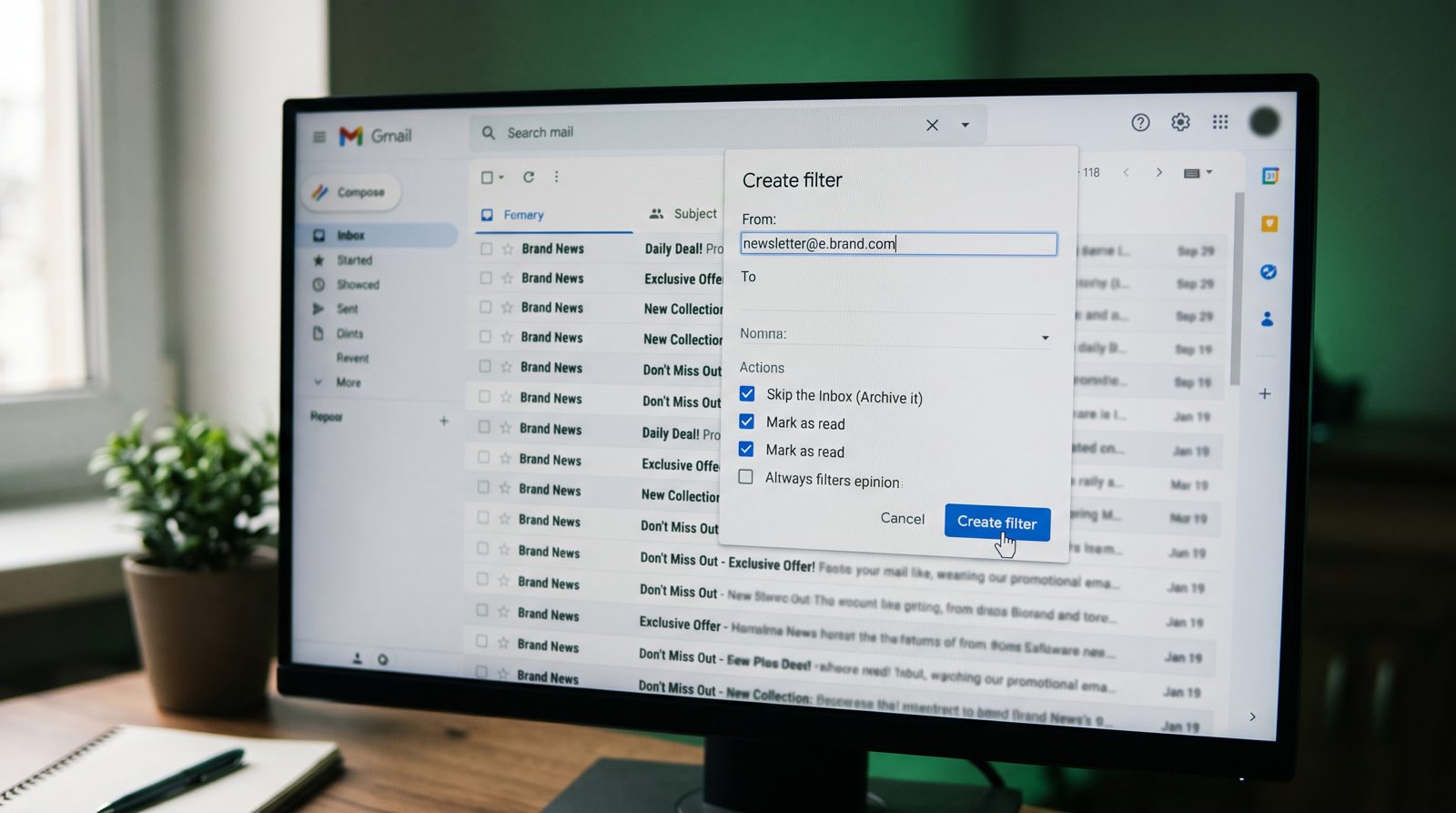
The fix is a filter that acts at the domain level, not the message level. In Gmail, from:(domain.com) plus "skip inbox" and "mark as read" removes a sender permanently in about fifteen seconds. Do that to your top five offenders and watch what happens to tomorrow's count. You are not organizing; you are amputating. One good filter outperforms a weekend of tidying because it works on everything that sender will ever send you, forever, without your attention.
What does an interrupting email really cost me?
Far more than the thirty seconds it takes to read. Gloria Mark, the UC Irvine researcher who's studied attention for two decades, found it takes an average of 23 minutes and 15 seconds to fully return to a task after an interruption. Her work, detailed in Attention Span, also found that people check email and messaging roughly 74 times a day and switch screens about every 47 seconds.
Multiply that out. Even a fraction of your 121 daily emails arriving as a live interruption is an attention bill that dwarfs anything an unread badge implies. This is why the real lever isn't reading faster — it's stopping the ping. Batch delivery, aggressive filters, and tools that summarize the noise so you read it on your schedule all attack the same thing: the count was never the enemy. The context switch was. An AI advisor that summarizes email does the same job from the other end, compressing a dozen threads into something you read once.
So what do I do on Monday morning?
Stop sorting and start subtracting. Open your sent folder's opposite — the senders you never reply to — and triage by volume, not by anxiety. The retailer and the notification bot go to a filter. The newsletter you actually read stays. The thing that pings you about every document edit gets its setting turned off at the source, inside the app, not in your inbox.
Unsubscribe is better than filter when it's legal mail, because a filter still costs the recipient server a delivery and you a storage line; a real unsubscribe stops it at the sender. The federal CAN-SPAM Act requires that unsubscribe link to work within ten business days, so it's not theater. Spend fifteen minutes killing five domains instead of three hours organizing a thousand. The thousand doesn't matter. The five do.
Sources
- Radicati Group — Email Statistics Report, email volume per user per day
- Gloria Mark / UC Irvine — research on interruption recovery time and attention switching; see 'Attention Span' (2023)
- FTC — CAN-SPAM Act compliance guide — ten-business-day unsubscribe requirement
- 43 Folders — Merlin Mann — original 'inbox zero' concept, 2007