read receipts
The 'Your Data Was Leaked' Email That Is the Leak
Breach-notification phishing works because the premise is true. Here's the one line that gives the fake away.
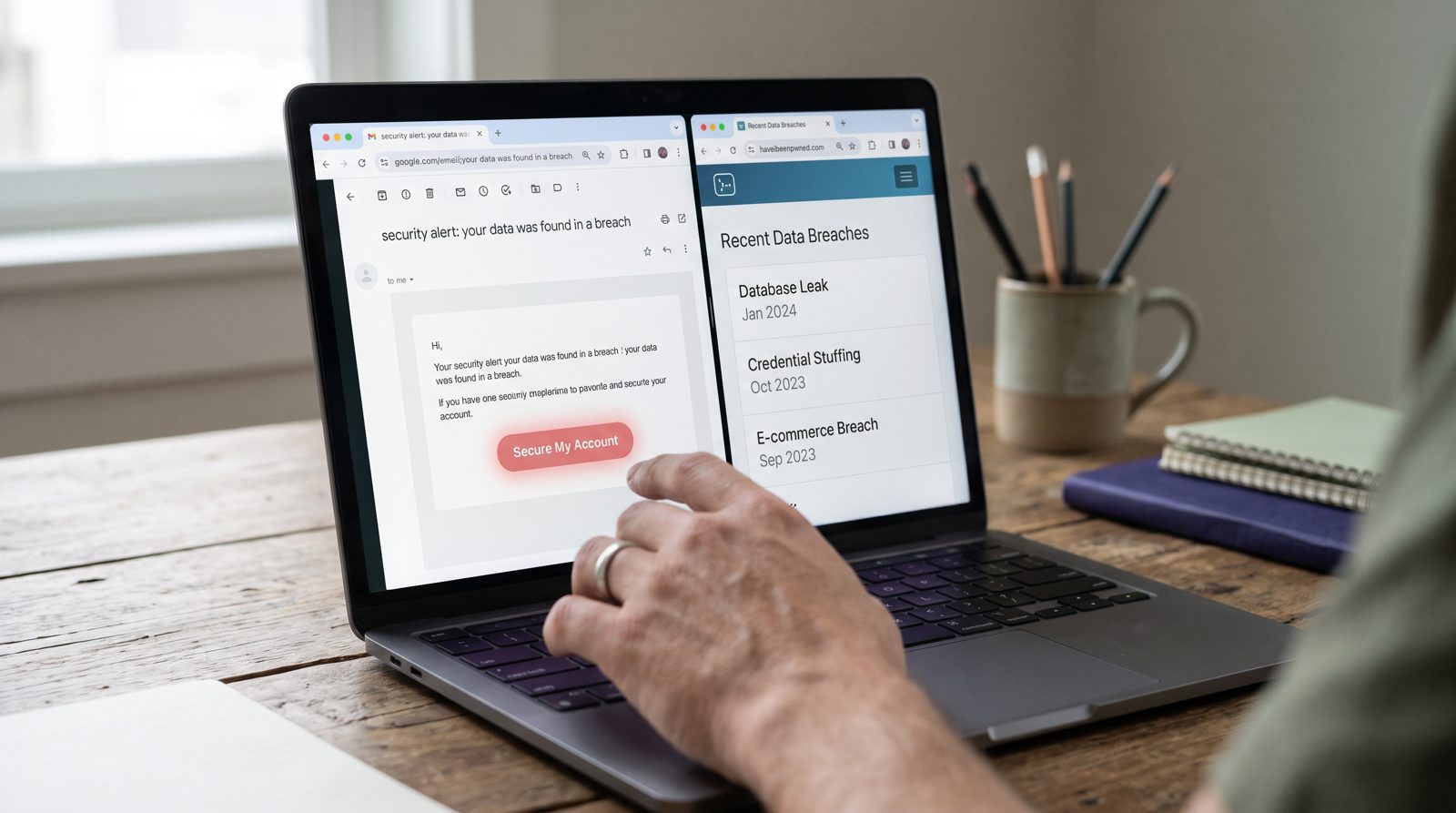
The most effective phishing email you'll get this year will tell you, truthfully, that your data has been exposed. Then it asks you to log in and "secure your account" — and that login page is the actual theft. The premise is real; the fix is the scam. Legitimate breach alerts never ask you to sign in from the email. That one rule catches almost all of them.
Why does a fake breach alert feel so convincing?
Because your data almost certainly was in a breach, so the email isn't lying about the one thing you could check in your gut. Have I Been Pwned, the breach-tracking service run by Troy Hunt, holds more than 14 billion compromised accounts across thousands of incidents — from the 2013 Yahoo breach that eventually touched all 3 billion accounts to the LinkedIn and Dropbox dumps that still circulate. Pull up your own email address there and you'll probably see a grim little list.
Scammers know this. They don't need to guess whether you've been exposed; the odds are overwhelmingly in their favor. So "your password was found in a data breach" reads as plausible on arrival. The anxiety does the persuading. By the time you're worried, you're already halfway to clicking, and the attacker hasn't had to prove anything.
What's the one tell that separates real from fake?
Real breach notifications tell you what happened and tell you to go log in yourself, at an address you already know. Fakes hand you a button. That's the whole distinction.
The FTC's own data breach response guidance, written for the companies doing the notifying, tells them to describe what was exposed and what people should do — not to route customers through a link in the message to re-enter credentials. A company that just lost your data is not going to train you to trust login links in email; that's the exact behavior that caused the mess. So when an "Okta security alert" or "Netflix account breach" message contains a prominent Verify Now or Secure My Account button, treat the button as the attack. Open a new tab, type the company's address by hand, and check there. If something's real, it'll be waiting for you inside.
How do I actually confirm whether I was breached?
Check it against the source, not the email. Go to haveibeenpwned.com directly, enter your address, and see which breaches actually list you — with dates and what fields leaked. That's a neutral, public record maintained independently of whoever is emailing you.
Then read the sender like a technician for a second. Breach phishing usually fails SPF, DKIM, or DMARC — the three checks that confirm a message really came from the domain it claims. Most webmail clients will show you "signed by" and authentication results if you open the full headers. A "security team" email that can't prove it came from its own domain is telling on itself. This is the kind of forgery an AI filter catches cheaply, which is part of why how xmail flags phishing leans on those signals before you ever see the message. If you do find a real breach, the move is boring and effective: change that password, enable two-factor, and stop reusing it anywhere else.
What do the attackers get if I click?
Your live credentials, which are worth far more than the old leaked ones. The breach that scared you into clicking might be two years stale, with a password you've already changed. The phishing page captures the current one, plus often the one-time 2FA code if they relay it in real time.
This is why breach-notification lures outperform random "account suspended" spam: they convert fear about old data into fresh access. The FTC and the FBI's IC3 both report identity-theft and account-takeover complaints in the hundreds of thousands each year, and a credential harvested through a convincing "we got breached" email feeds straight into that pipeline. The grim joke is that clicking to secure yourself against one breach is how you star in the next one.
Sources
- Have I Been Pwned — breach dataset and account count
- FTC: Data Breach Response Guide for Business — how legitimate breach notifications are supposed to work
- FBI IC3 — annual complaint and loss reporting