read receipts
The Newsletter You Can't Quit Is Three Companies Sharing One Mail Server
You unsubscribed. The email kept coming. Here's why the link was never the point.
You click unsubscribe, you get a cheerful "you're all set," and two days later the same deals land in your inbox from a slightly different name. That's not a broken button. The brand you trusted sold or rented your address downstream, and the sender you just unsubscribed from was never the one actually mailing you. The fix lives in the headers, not the footer link.
Why does unsubscribing from one of these senders do nothing?
Because you unsubscribed from a front, not a list. When you hand your email to one site at signup, a "co-registration" or "partner offers" checkbox (often pre-checked, often buried) licenses that address to a chain of advertisers and list brokers. The U.S. CAN-SPAM Act requires a working opt-out and says senders must honor it within 10 business days — but each legally distinct sender only has to stop its own mail. Unsubscribe from "DailyDealVault" and "SmartSaverAlerts" is untouched, even though the same marketing shop runs both. You're playing whack-a-mole against one hand wearing different gloves. The Federal Trade Commission, which enforces CAN-SPAM, can fine violators up to $53,088 per email — but only if you can prove who sent it and that they ignored a valid request, which is exactly the thing list-brokering is designed to blur.
How do I tell three companies apart when they're all one operation?
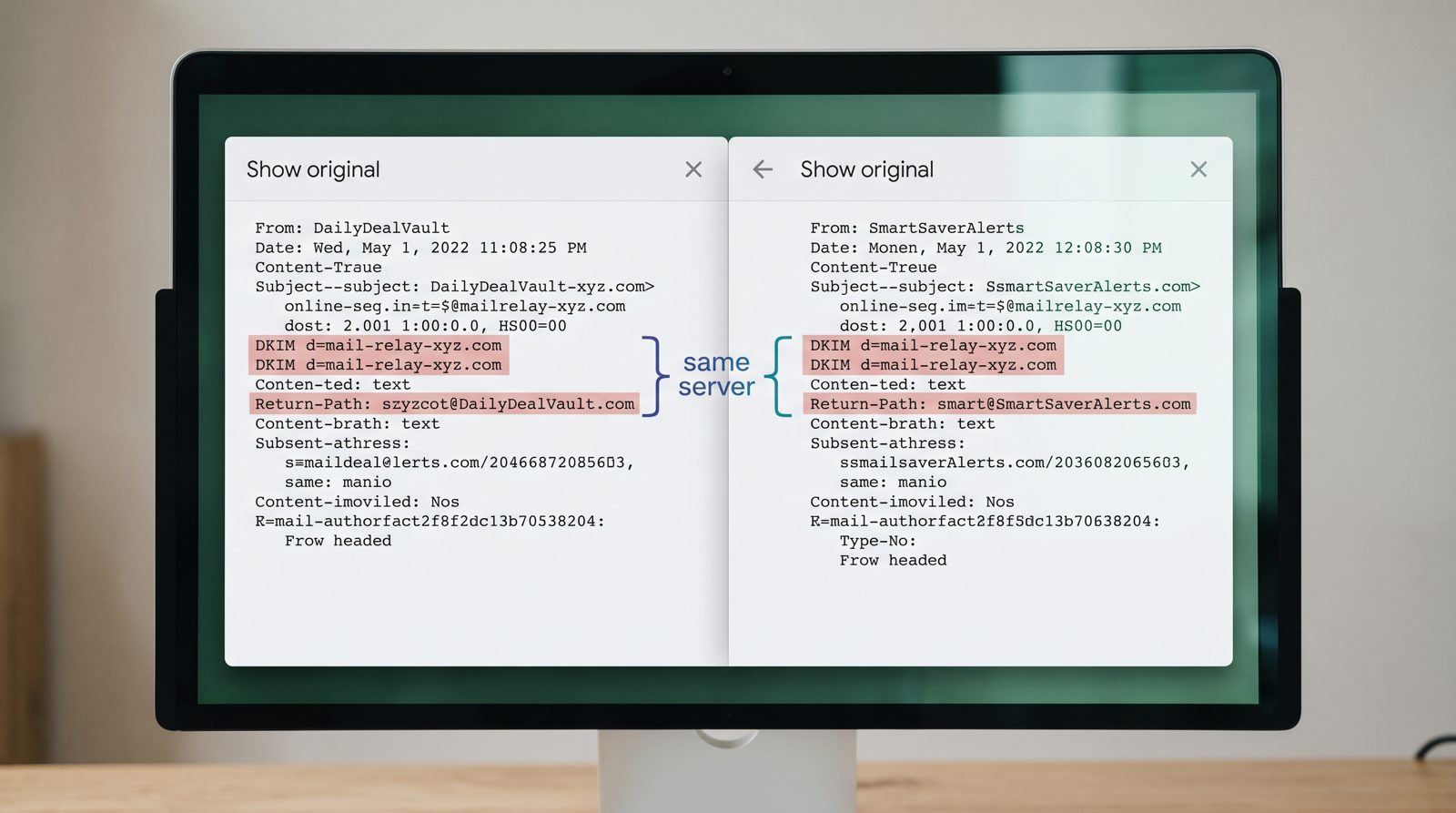
Open the full headers and look at the sending infrastructure, because the brand names are costume; the plumbing is the tell. In Gmail that's "Show original." You're hunting for three fields: the Return-Path (the real bounce address), the DKIM signing domain (d=), and the IP or sending domain in Received. When "DailyDealVault" and "SmartSaverAlerts" both DKIM-sign as d=mail-relay-xyz.com and both bounce to the same Return-Path at the same email service provider on the same shared IP block, you're looking at one operator mailing from one platform. Brands that genuinely run their own program sign with their own domain. A rented list signs with the broker's. Once you see the shared d= value, you know clicking unsubscribe on sender A does nothing about sender B — same server, different letterhead.
So what actually stops the flood?
Stop fighting individual senders and cut the infrastructure off, because that's the only move that touches all the trench-coat layers at once. Three things work. First, a filter on the shared signal you found — many clients let you filter by sending domain or header, so one rule nukes every alias on that relay. Second, report as spam rather than unsubscribe on anything suspicious; that trains your provider's model on the sending reputation, which is shared across the operator's whole stable. Third, starve the brokers upstream by never reusing one address everywhere. A plus-tag or an aliasing setup tells you which signup leaked, and AI inboxes increasingly read these headers for you and flag suspicious senders before you squint at a Return-Path. The unsubscribe link was built to make you feel busy. The mail server is where the decision actually gets made.
Is clicking unsubscribe ever a trap?
Sometimes, and the same header read tells you which. A legitimate list honoring CAN-SPAM gives you a one-click or single-page opt-out with no login. But on a cold list you never joined, clicking can simply confirm a live human reads this address — which makes it more valuable, not less, to the next broker down the chain. The rule of thumb: if the sender passed SPF, DKIM, and DMARC alignment and you recognize the signup, unsubscribe. If the authentication is a mess or the address is one you never gave out, don't click anything — filter the sending domain and report it. You're not rude for refusing to RSVP to a party that forged the invitation.
Sources
- FTC CAN-SPAM Compliance Guide — opt-out, 10-day rule, per-email penalty
- Federal Register, FTC civil penalty adjustments (2024) — inflation-adjusted CAN-SPAM penalty amount
- IETF RFC 6376 (DKIM Signatures) — the d= signing-domain field in email headers