read receipts
Gmail Reads Your Receipts Before You Do, and Scammers Know It
The package card that appears before you open the email isn't magic. It's markup anyone can copy.
That tidy card at the top of your inbox showing your Amazon order will arrive Thursday wasn't conjured by an AI reading your mind. Gmail found a block of schema.org markup the sender buried in the email's HTML, parsed it, and drew the card for you. Which means a scammer who pastes the same markup can make a fake order look exactly as confirmed as a real one.
How does Gmail know a package is coming before you read the email?
The sender tells it, in a machine-readable language Gmail asks them to speak. Google's developer docs for email markup are explicit: retailers and airlines embed structured data using schema.org vocabulary, either as JSON-LD or microdata, inside the message HTML. An order confirmation carries an Order object with fields like orderNumber, orderStatus, and a nested ParcelDelivery with expectedArrivalUntil and a tracking URL. A flight carries a FlightReservation with the departure airport, the gate, the boarding time.
Gmail's parser reads those fields and renders them as highlights at the top of the inbox and inside the message. No AI is "understanding" your travel plans. It's reading labeled data the way a browser reads an address field. The intelligence is almost entirely in the sender's HTML, not in Google's black box.
Why does that make fake orders more convincing, not less?
Because the markup is just text, and text copies. There is no cryptographic bond between "this card says your order shipped" and "this order is real." Google's schema registration process checks a sender's volume and formatting before it enables rich cards at scale, but the underlying JSON-LD is sitting in plain sight in every legitimate confirmation you've ever received. Open one, view source, and there it is.
A scammer scrapes that block, swaps in their own tracking link and a fake order number, and sends it. If the message clears authentication, Gmail may happily draw a crisp "arriving soon" card above an email that's pure bait. The visual trust you've built up over a hundred real deliveries gets borrowed for free. The card looks official because the format is official. The contents are whatever the sender typed.
What actually separates a real confirmation from a forged one?
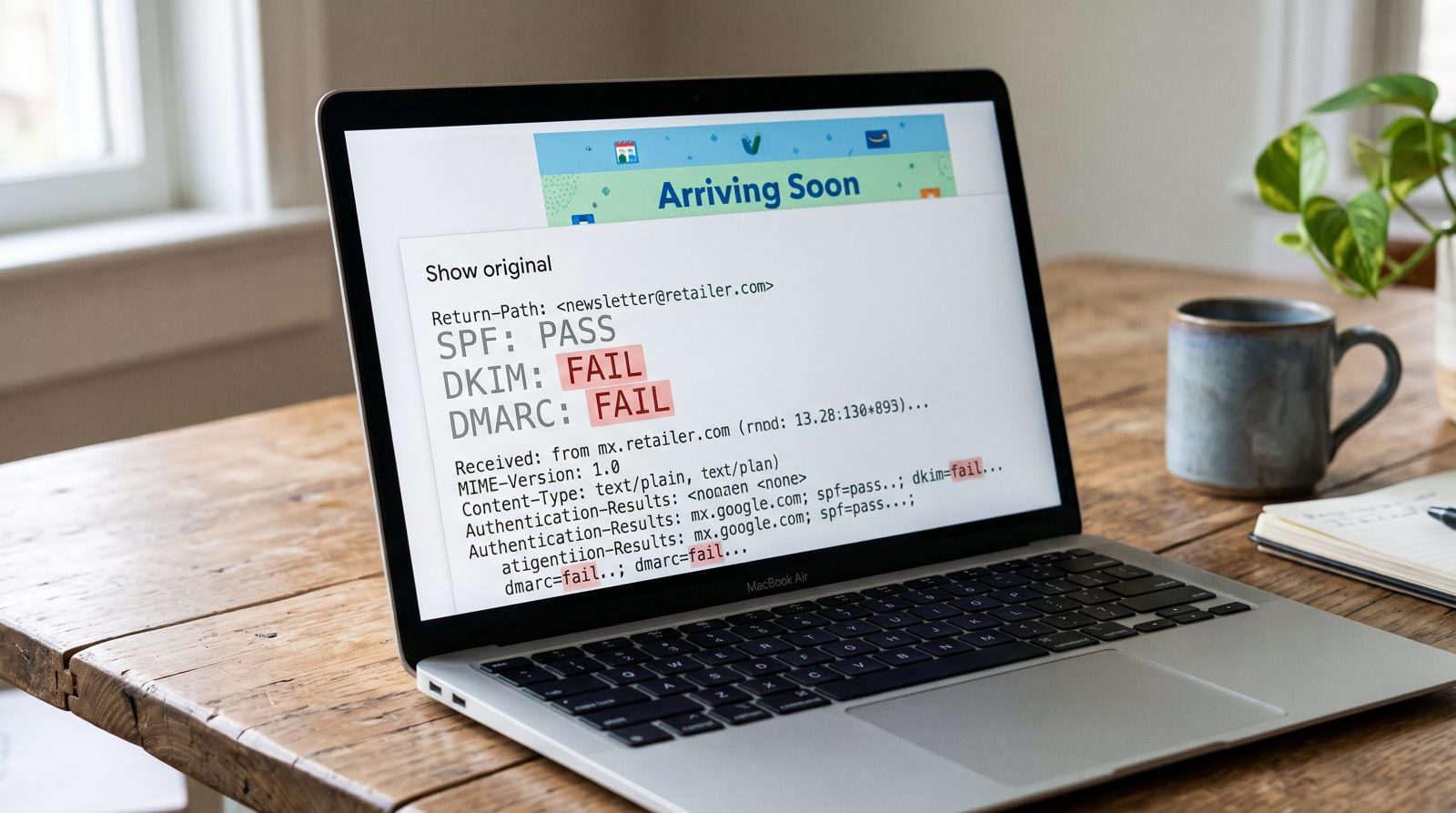
Not the card. The authentication headers underneath it. Three checks decide whether a sender is who they claim: SPF confirms the sending server is authorized for the domain, DKIM is a cryptographic signature on the message body, and DMARC tells receivers what to do when SPF or DKIM fail. Google and Yahoo made this non-optional for anyone sending more than 5,000 messages a day to their users starting in February 2024. Bulk senders without valid DMARC get rejected or junked.
That's the layer worth trusting, and it's the one no card shows you. In Gmail, open the message, hit the three-dot menu, choose "Show original," and look for PASS on SPF, DKIM, and DMARC. A forged "order shipped" email that spoofs a real retailer will usually fail DKIM or come from a domain that doesn't align. The pretty card can't lie about delivery dates; the headers can't lie about who sent it. Tools that read those headers for you, including the scam-flagging in AI email like xmail, are checking the same thing, just faster than you'd do it by hand.
What should you do when a surprise package card shows up?
Trust the tracking you initiated, not the tracking that arrived unannounced. If a card claims a delivery you don't remember ordering, don't tap its link. The tracking URL inside forged markup is the whole point of the con, often leading to a "pay this customs fee" or "confirm your address" page that harvests card details. The U.S. Postal Inspection Service and the FTC have both warned repeatedly about fake-delivery texts and emails doing exactly this.
Instead, go to the retailer or carrier directly, type the address yourself, and paste the tracking number there. If the order doesn't exist in your real account, the card was theater. And if you want a tell before you even click: a genuine shipping email almost always comes from a domain you've transacted with and passes DMARC. A forged one is frequently sent from a lookalike domain that fails alignment, with a card sitting on top like a borrowed uniform.
Sources
- Google for Developers: Email markup — schema.org structured data for orders, flights and highlights in Gmail
- Google: Email sender guidelines — SPF, DKIM and DMARC requirements including the 5,000/day bulk sender rule from Feb 2024
- FTC Consumer Advice: fake delivery scams — warnings on fake package and delivery notification phishing